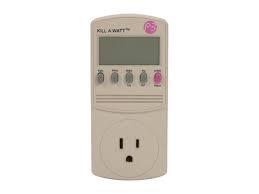
With the intent of decreasing our home’s electricity usage, I measured the electrical usage of many of the appliances, toys, gadgets, etc. in the house using a device called a Kill-A-Watt. It’s an inexpensive device that goes between your device and the wall outlet. Among other features, it can tell you how many watts a device is drawing at the moment or how many kilowatt-hours it has used over time.
In the tables below, I am using 11 cents per kilowatt hour for computinpg the costs, since that’s about what power costs here. Note: I can only measure devices that plug into a 110V socket, so the air conditioner and dryer can’t be measured.
I divided the devices in my house into three basic categories based on how they are used. The first category is devices that run in batches or cycles. Here’s a table showing how much power each cycle consumes. Note: these figures only measure the electricity used by the device itself, not in heating the water, etc.
The second category is devices that run all the time, including appliances like the fridge. I’ve also included the devices in the home that draw power even when off. For instance, notice that the TV draws 2 watts when it’s “off”, since it’s still doing things like listening for the remote control.
The final table shows items that are measured by the hour. Even the most power-hungry devices don’t cost much per hour, so I included a column to show you how many hours $1 of electricity will buy you.
Here’s the data.
To sum up, here were the main things that I found surprising or insightful:
- For CRT monitors, displayed a white screen takes far more power than a black screen
- If you’re cold at night, use an electric blanket, not a space heater!
- The DVR never really shuts off.
- Spinning down the hard drive in the desktop computer isn’t a huge power savings, but standy is.
- The desktop computer only uses marginally more power when very busy compared to at idle.
I’ve got a few more things to measure, but if you have any requests, let me know. Also, if I know you, you’re free to borrow my kill-a-watt to measure stuff around your place.
Related Projects

Repurposing an old tool case to make a soldering station portable
Testing capacity of commonly available (well, in 2007) AA Nickle Metal Hydride batteries.
Modifying a popup camper RV bunk end 12V light to add a nightlight feature.


Interesting findings! Although, just FYI, the spreadsheets aren’t visible from some places of business like mine that block sites filtered as “Personal Network and Storage”, like http://spreadsheets.google.com/. I suppose that’s not a big deal for a single blog record, but if you want to display spreadsheets on a high-traffic static page, it poses accessibility issues…
I’ve been trying to figure out why my electric bills are extraordinarily high, starting with a spreadsheet like this. But the numbers weren’t adding up. I interrogated some hapless PG&E person for like 45 minutes to understand their billing system.
The key is the baseline, and the tiers. With our baseline monthly allowance the power is about 11¢.kW/h. But as you exceed that baseline allowance the price per kW/h goes up. By the 5th tier (which I frequently hit) it’s up to 44¢.
Since it’s aggregated monthly, it becomes really hard to tell how much something really cost you that month. I’ve found it more useful to look at things in terms of the portion of baseline. For example, a 2-amp furnace fan that we leave running all the time for HEPA filtration consumes 5.76kW/h per day. In a 30-day billing cycle, at 11¢ per kW/h, it works out to $19/month. Not too bad considering the benefits to our allergies. BUT — that’s if nothing else was running. If we were in the 5th tier of usage above baseline, it quadruples. That’s starting to get expensive!
So the Pacific Gas and Electric lady pointed out that our winter baseline allowance in my area is 12.1kW/h per day. (The final tally is at the end of the month, but I’m calculating daily to eliminate the variable of how many days there are in a billing cycle.) That fan is burning 5.76kW/h per day — almost half my baseline! Running it all the time is going to virtually guarantee that we’ll exceed baseline, by a wide, expensive margin.
So I’m building a new spreadsheet that rates everything in kW/h per day so I can see which things are burning what percentage of baseline, and how far over baseline in percentage that these appliances are pushing us, in total.
Wow, I don’t see evidence of the tiered system on my service, but that’s not much of an allotment on your base tier.
What’s interesting, if my math is correct, is that a small diesel generator (which, according to Wikipedia might use between .28 and .4 liters of fuel per kilowatt hour) would cost about 20 cents per kilowatt-hour to run (only the cost of fuel).